
What should you check before comparing Plinko games?
Start with identity, not impressions. Plinko, Plinko GO and another game simply labelled Plinko can sit side by side while using different providers, row counts, risk labels, RTP variants and maximum multipliers. A screenshot of a ball dropping is not enough. You need the provider name, the exact title, the visible rules screen if available, and the paytable shown under the current settings.
This lab is built around that habit. It helps you separate four things that are often blurred together: the game edition, the control state, the money arithmetic and the device display. Once those are separated, contradictory listings become easier to read. A public page can name one supplier while describing another game's features, and a demo can show one configuration while a British operator selects another.
The practical conclusion is simple: never compare two Plinko games by name alone. Compare them by version, visible paytable and stake arithmetic. If one of those is missing, your comparison is incomplete.
Sources: Plinko GO (Branded) · Plinko by Hacksaw Gaming · Plinko Go at Paddy Power Games · Plinko Go at Midnite
What are the parts of a single Plinko round?
A single round is one paid drop under one chosen setup. You select a stake, choose the number of rows or lines if the game allows it, choose a risk level if offered, and then commit to that individual cycle. The ball lands in a bucket, the game displays a multiplier, and the result is calculated from that multiplier and your stake.
That sounds obvious, but it matters because many mistakes come from treating the interface as one continuous session rather than a series of separate commitments. In Great Britain, current remote technical standards require individual commitment to each game cycle, so you should not assume autoplay is available in a GB real-money client even if an international page mentions it.
The key fields to note are stake, rows or lines, risk, displayed multiplier, gross return and net result. If the game also shows virtual balance, label it properly. A FUN balance in a demo is not a cash balance, and a listed stake range on a product page is not proof of the live GBP range at a specific operator.
Sources: RTS8 Auto-play functionality · Our official public-demo control inspection, 22 October 2026 · Plinko GO (Branded)
How do you identify the exact Plinko version on screen?
Use a three-step version finder. First, record the exact title shown by the operator or demo page. Second, record the provider or studio named on the page or in the help screen. Third, open the rules or information panel and capture the RTP, stake range, row options, risk options and maximum multiplier shown there. If any of those conflict with the public listing, trust the in-game rules for the live configuration and treat the marketing page cautiously.
This matters because the same market can carry several different editions. 1X2gaming's Plinko GO is published with 96%, 94% and 92% RTP variants and a 420x maximum. Hacksaw's Plinko has 8 to 16 rows, three risk levels and several RTP variants. TaDa's Plinko has its own published figures, and one operator listing conflicts with the provider's stated maximum. Those are not cosmetic differences; they change the numbers you should use.
If the page names one studio but the provider material names another, do not silently merge them. Note the conflict and inspect the actual help screen before drawing conclusions. The same applies when an operator description borrows language from a different game. Version identification is an evidence task, not a branding exercise.
Sources: Plinko GO (Branded) · Plinko GO gamesheet · Plinko by Hacksaw Gaming · Plinko Go at Midnite · Plinko at Midnite (TaDa Gaming) · TaDa Gaming Plinko · Plinko Go at Paddy Power Games
What did the captured BGaming demo controls actually show?
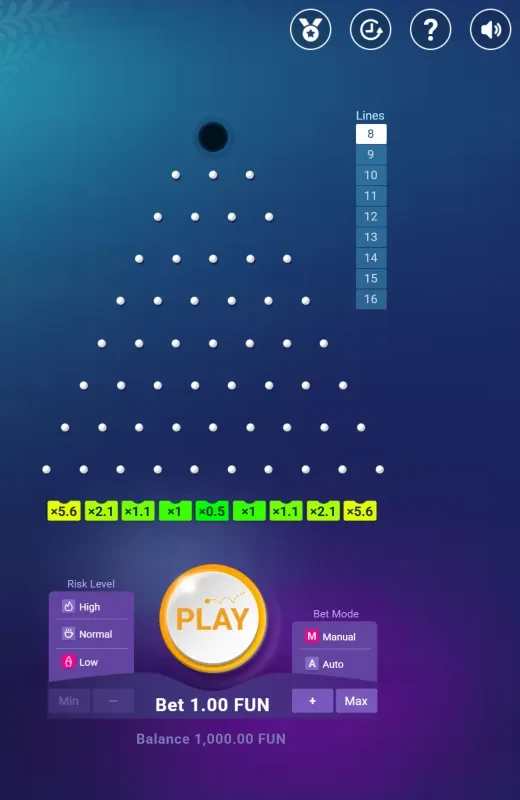
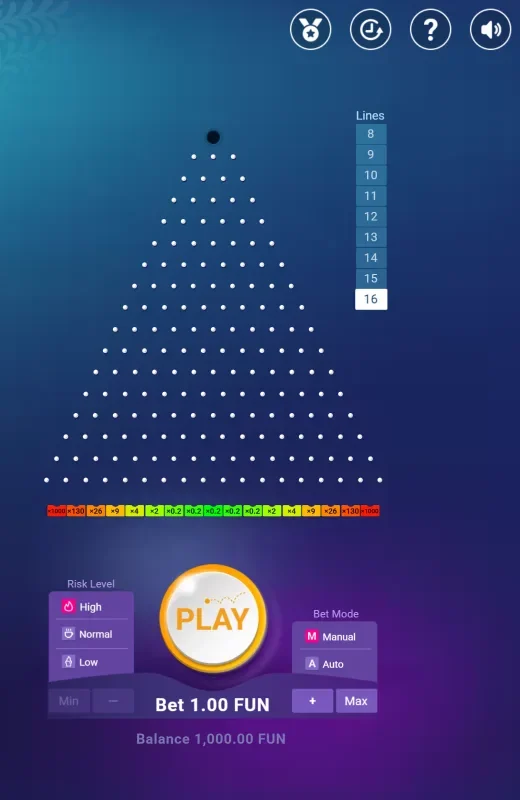
The captured BGaming public demo opened with 8 lines, Low risk, a 1.00 FUN stake per ball and a 1000.00 FUN virtual balance. The visible middle bucket showed 0.5x and the edge bucket showed 5.6x under that initial setup. After changing the interface to 16 lines and High risk, the displayed paytable changed: the middle showed 0.2x and the edges showed 1000x.
That is useful because it proves the control state changes the visible paytable. It does not prove a completed round, a funded account, a withdrawal, or a British operator configuration. The demo was an international FUN-mode interface, not a GB casino session, and no Play button was pressed in the inspection.
Treat this as a control map, not a result sample. It tells you where to look and what to record. It does not tell you what will happen next, and it does not turn a provider demo into evidence of local availability.
Sources: Our official public-demo control inspection, 22 October 2026 · BGaming original Plinko product page
How do stake, gross return and net result differ?
Stake is the amount you commit to one drop. Gross return is the amount the game credits for that drop before subtracting the stake. Net result is gross return minus stake. If you stake £2 and the bucket pays 0.5x, the gross return is £1 and the net result is -£1. If the bucket pays 1x, the gross return is £2 and the net result is £0. If it pays 5x, the gross return is £10 and the net result is +£8.
This distinction stops a common reading error: a return below 1x is still a return, but it is a net loss. A 0.2x result on a £2 stake returns £0.40 gross and leaves you £1.60 down on that drop. The game has not returned nothing; it has returned less than you staked.
Use the same language every time. Stake is exposure for that drop. Gross is what comes back. Net is what changed. Once you keep those separate, paytables become much easier to compare across rows and risk settings.
How do you calculate total exposure over several drops?
Total exposure is the sum of stakes across the drops you intend to make. If you make 20 drops at £0.50 each, your total staked exposure is £10. That is not the same as a deposit, and it is not the same as a withdrawal. It is simply the amount you have committed across those cycles.
Now compare that with total gross returns. If those 20 drops return £8 in total, the net result is -£2 and the observed sample return is 80%. That is an observed sample only. It is not long-run RTP, and it does not predict the next 20 drops. Small samples can sit far above or below the theoretical expectation.
A useful lab habit is to write three numbers before you start: stake per drop, number of drops, and total exposure. Then write two numbers after: total gross returned and net result. That gives you a clean record without pretending that a short session proves anything about the game's maths.
How should you read rows, risk and multipliers together?
Rows, risk and multipliers are one system, not three separate facts. Changing rows or risk can change the visible paytable, which means the same stake can produce a different spread of outcomes under a different setup. In the captured BGaming demo, moving from 8 lines and Low risk to 16 lines and High risk changed the displayed middle and edge multipliers immediately.
That is why a screenshot of one bucket value is weak evidence. You need the full control state. A high edge multiplier means little unless you also know the row count, the risk setting, the stake and the rest of the paytable. A lower-risk board may show smaller swings; a higher-risk board may show more extreme values. Neither setting creates a winning strategy.
Read the paytable as a snapshot of the current configuration. If the game lets you change settings, recheck the multipliers after every change. Do not assume the last seen values still apply.
Sources: Our official public-demo control inspection, 22 October 2026 · Plinko by Hacksaw Gaming · Plinko GO (Branded)
Why does provider RTP not settle the operator RTP?
Provider RTP is often published as a set of variants, not one universal figure. Hacksaw publishes several RTP variants for Plinko. 1X2gaming publishes 96%, 94% and 92% for Plinko GO. MrQ publicly lists 94.30% for its Hacksaw Plinko page, which is one specific listing, not proof that every operator uses the same setting.
The correct lab question is not 'What is the highest RTP this provider advertises?' It is 'What RTP is shown for the exact game at the exact operator I am inspecting?' A public listing is useful evidence, but the strongest confirmation is the live in-game rules screen for the selected build.
A theoretical 94.30% RTP means a 5.70% house edge under that stated configuration. Across £1,000 of turnover, the mathematical expected cost is £57. That is not a session prediction, and a £100 deposit is not £1,000 of turnover. Keep the denominator explicit whenever you use RTP in arithmetic.
Sources: Plinko by Hacksaw Gaming · Plinko GO (Branded) · Plinko at MrQ
How do you check whether the game is usable on your device?
A game can load correctly and still be awkward to use. In the captured demo inspection, portrait mobile emulation scaled the controls too small for comfortable use. Landscape or fullscreen was the better option, and the provider's own page was preferable to a cramped embedded view. That is a real usability limitation, not a passed physical-phone test.
For your own device, check four things: whether the game loads without a session error, whether the controls remain readable, whether the stake and risk buttons are easy to hit accurately, and whether the help screen opens without obscuring the paytable. A clean load is not enough if the buttons are too small to use safely.
Treat this as a personal device result only. Browser emulation is useful for spotting layout problems, but it is not the same as testing every handset, browser and operator app. If the interface is hard to read, stop and switch view rather than fighting the screen.
Sources: Our official public-demo control inspection, 22 October 2026
What should you do when a listing contradicts the provider page?
Do not average the two versions and do not pick the more exciting number. Record the conflict and identify which source is describing which layer. A provider page describes the supplier's published game specification. An operator listing describes what that operator says it offers. The live in-game help screen is the best place to settle the selected configuration for that operator.
There are real examples in the current evidence set. Paddy Power's Plinko Go page names 1x2 Network and shows 94.00% RTP, but the body text describes Ricochet and up to 7,000x, which does not match the official 1X2gaming material. Midnite lists Plinko Go but attributes it to Iron Dog Studio while the provider identifies 1X2gaming. TaDa's own page says 1,000x while a Midnite listing says 1,050x.
The safe response is to label the contradiction plainly and avoid turning it into a feature claim. If you cannot verify the live rules, say so. A careful 'not yet confirmed' is more useful than a confident but wrong summary.
Sources: Plinko Go at Paddy Power Games · Plinko GO (Branded) · Plinko GO gamesheet · Plinko Go at Midnite · Plinko at Midnite (TaDa Gaming) · TaDa Gaming Plinko · TaDa Gaming Plinko gamesheet
Why does Great Britain versus Northern Ireland matter here?
This site is written for Great Britain because the Gambling Commission's remit under the Gambling Act 2005 covers England, Scotland and Wales. Northern Ireland has separate arrangements, and the Commission does not regulate gambling activity there in the same way. That matters when you read licence checks, technical standards and consumer guidance.
So when this lab talks about GB real-money controls, it is not making a blanket claim for every part of the UK. It is talking about the GB regulatory context. A game page, a demo, or a provider specification may be visible internationally while still telling you nothing reliable about the live British configuration.
Keep that scope attached to the assertion. A GB licence check supports GB operator identity. It does not prove Northern Ireland availability, and it does not turn an international demo into local evidence.
Sources: Our role and remit in Northern Ireland · Register of gambling businesses
What is the fastest lab checklist before you trust what you see?
Use this order: title, provider, rules screen, RTP, stake range, rows or lines, risk setting, visible paytable, device fit. Write those down before you compare one game with another. If the page is a demo, label the currency correctly. If it is an operator listing, separate public listing from live in-game confirmation. If it is a forum claim, treat it as a lead, not proof.
Then do the arithmetic in plain £ terms. Choose a hypothetical stake, calculate gross and net for a few multipliers, and work out total exposure for the number of drops you are considering. That gives you a concrete picture of risk without pretending you can forecast results.
The lab mindset is disciplined but simple: identify the version, read the visible numbers, keep the denominators straight, and do not let a polished interface do the thinking for you.
Sources: Our official public-demo control inspection, 22 October 2026 · Plinko by Hacksaw Gaming · Plinko GO (Branded) · RTS8 Auto-play functionality