
What is one complete Plinko drop?
A complete online Plinko drop is one paid game cycle, not a session and not a deposit. You choose a stake, confirm the board settings offered by that exact game, press the play control once, the ball falls through the peg field, and it lands in a bucket showing a multiplier. The game then applies that multiplier to the stake for that drop only. If you play again, that is a new commitment with its own stake and result.
Keep the money language separate. The stake is the amount charged for that drop. The gross return is stake multiplied by the landing multiplier. The net result is gross return minus stake. With a hypothetical £2 stake, a 0.5× bucket returns £1 gross and therefore a £1 net loss; a 1× bucket returns £2 gross and £0 net; a 5× bucket returns £10 gross and £8 net profit. A return below 1× is still a loss even though money comes back.
This matters because Plinko screens often show several numbers at once: balance, stake, last win, multiplier and sometimes a table of bucket values. The balance is not a stake, the last win is not a prediction, and a multiplier is not a probability. Before treating any screen as real money, identify which denomination is being used. A demo may show FUN credits, an operator page may show pence or pounds, and a provider PDF may use another currency entirely.
Sources: Our official public-demo control inspection, 22 October 2026 · TaDa Gaming Plinko gamesheet
What are the board, pegs, rows and balls?
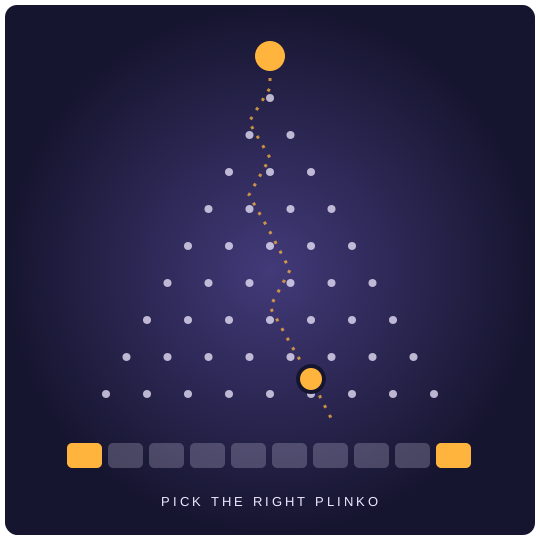
The board is the triangular or staggered field of pegs that sends the falling ball left or right before it reaches a row of landing buckets. Rows are the number of peg levels the ball passes through; more rows usually mean more possible landing positions and a wider spread between middle and edge multipliers. Buckets sit at the bottom and carry the payable multipliers for the selected configuration.
The ball is the object whose path is animated through the board. In a licensed online game, treat the animation as the presentation of a settled result rather than a skill surface you can steer. Manual timing of the press does not aim the ball. A physical party board, television board or home-made peg board can be genuinely mechanical, but that does not make its probabilities transferable to a digital casino edition.
Different named games also use the same broad anatomy with different rules. Hacksaw’s Plinko product material describes 8–16 rows and low, medium and high risk, while 1X2gaming’s Plinko GO material describes configurable board size and volatility with a different maximum multiplier. The shared visual grammar can hide important differences, so the exact title, provider and in-game help matter more than the fact that both look like a ball dropping through pegs.
Sources: Plinko by Hacksaw Gaming · Plinko GO (Branded) · Plinko GO gamesheet
How do stake, rows and risk change a round?
Stake is the only setting that directly changes the amount of money at risk on that drop. Rows and risk change the paytable shape. In general, more rows give the design more landing positions, while higher risk usually pushes more value toward the outer buckets and makes low central returns more punishing. The exact effect is not universal; it must be read from the displayed paytable for the game and configuration in front of you.
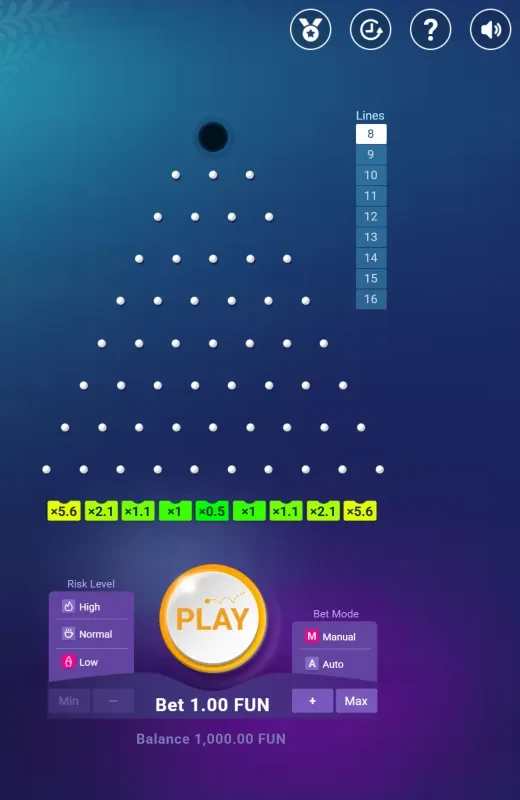
A captured international BGaming demo illustrates the distinction without proving any British configuration. Its initial interface showed 8 lines, Low risk and 1.00 FUN per ball, with a visible middle bucket of 0.5× and an edge of 5.6×. After selecting 16 lines and High risk in that demo, the displayed middle bucket became 0.2× and the edges showed 1000×. Changing risk or lines changed the displayed paytable; it did not change money, because the balance was virtual, and it did not create any guarantee.
Use a simple British illustration. Suppose a game allowed a 50p stake and you made 20 separate drops. Your total staked exposure would be £10, regardless of whether individual drops returned 20p, 50p or more. If those 20 drops returned £8 in total, the observed sample return would be 80% for that small set, not proof of the game’s long-run RTP. Stakes are not deposits, and returns are not withdrawals; each amount answers a different question.
Sources: Our official public-demo control inspection, 22 October 2026 · Plinko by Hacksaw Gaming · Plinko GO (Branded)
How do multiplier, gross return and net result differ?
The multiplier is a factor applied to the stake for that drop. Gross return is the amount credited back from that drop before subtracting what you paid. Net result is the part that tells you whether the drop won or lost money. Players often say a bucket “paid” because credits came back, but a 0.2× or 0.5× result still leaves you worse off than before the drop.
For one hypothetical £2 stake: 0.2× gives 40p gross and a £1.60 net loss; 0.5× gives £1 gross and a £1 net loss; 1× gives £2 gross and breaks even on that drop; 5× gives £10 gross and an £8 net gain. These are arithmetic examples, not observed outcomes. The same formula works in pence: a 10p stake at 0.5× returns 5p gross, which is a 5p net loss.
This distinction also protects you from misreading streaks. Ten drops at £1 cost £10 total staked. If nine return 50p and one returns £3, gross returns are £7.50 and the net result is minus £2.50. Describing that as “nine wins” because credits came back would be wrong. Count drops by net result, and count affordability by total staked exposure rather than by the largest single return.
How do you know which Plinko version you are playing?
Start with the exact title and provider, not the word Plinko alone. British public listings currently include more than one same-name or similar-name edition. MrQ’s public page names Hacksaw and displays 94.30% RTP with 10p to £25 stakes. Midnite has separate public listings for a Hacksaw Plinko, a TaDa Gaming Plinko and a Plinko Go card, while Paddy Power lists Plinko Go with 1X2 Network shown as supplier. These are listing checks, not proof of the live in-game configuration.
The differences are not cosmetic. Hacksaw publishes several RTP variants and a maximum win of 3,843.3×. 1X2gaming’s Plinko GO material publishes 96%, 94% and 92% RTP variants and a 420× maximum. TaDa’s own material advertises a 1,000× maximum, while Midnite’s TaDa page advertises 1,050×; that conflict should stay attributed rather than be silently resolved. A provider page is supplier evidence, while an operator page is a listing for that business.
The practical method is to open the game’s own help or information screen after identifying the title and operator. Use the public listing to find the game, then use the in-client rules to settle the selected RTP, stake range, rows, risk labels and paytable. If the help screen conflicts with marketing text, treat the in-game rules as the version-specific source for that play session and keep the contradiction visible rather than guessing.
Sources: Plinko at MrQ · Plinko at Midnite (Hacksaw) · Plinko at Midnite (TaDa Gaming) · Plinko Go at Midnite · Plinko Go at Paddy Power Games · Plinko by Hacksaw Gaming · Plinko GO (Branded) · TaDa Gaming Plinko
What changes between demo play and real-money play?
A demo is for learning controls and reading a paytable without staking money. The official BGaming public demo is an international FUN-currency version, not a verified Great Britain licensed casino configuration. Our inspection captured controls and help access only: no Play press, no bets, no completed-round sample, no funded account and no withdrawal. It is useful for anatomy, not for proving what a British operator offers.
Real-money play adds account verification, operator terms, actual stake limits, safer-gambling controls and the selected commercial configuration. A demo balance of 1,000.00 FUN is not £1,000, and a demo paytable is not a promise that the same RTP or maximum is active elsewhere. Even where a Demo label appears on an operator listing, that does not prove access without registration or age checks.
Use demo play to answer narrow questions: where the stake control is, how rows and risk change the visible buckets, whether the help button opens rules, and whether the screen is usable on your device. Do not use it to forecast wins, test a system or assume a British version will match. For money play, the licensed operator’s own game client and terms are the relevant evidence.
Sources: BGaming original Plinko product page · Our official public-demo control inspection, 22 October 2026 · Plinko at Midnite (Hacksaw) · Age, ID and financial verification
Which controls should British players not expect?
Great Britain’s remote technical standard RTS8 requires systems to make the player commit individually to each game cycle. In plain terms, a compliant British real-money client should not ask you to set a batch of Plinko drops to run automatically. Some operator marketing still mentions autoplay, including MrQ text describing up to 1,000 rounds and Midnite’s TaDa page advertising autoplay; those statements should not be republished as available British controls.
This guide therefore gives no autoplay instructions for GB real-money play. The safer reading is that each drop needs its own deliberate press. That also fits the maths: every press is a fresh stake decision, and speed does not improve the paytable. If a screen appears to offer rapid repeated play, stop and read the rules and safer-gambling settings rather than treating convenience as approval.
Manual timing deserves the same caution. Pressing earlier or later does not aim the ball, and watching previous balls does not load the next one toward an edge. A physical board can be influenced by construction and release; a licensed digital instant-win game presents an outcome through animation. Do not import party-game intuition into a paid client.
Sources: RTS8 Auto-play functionality · Plinko at MrQ · Plinko at Midnite (TaDa Gaming)
Is there a universal British Plinko stake limit?
No universal £2 or £5 Plinko cap is established here. The online slots stake-limit guidance introduced a £5 limit from 9 April 2025 and a £2 limit for 18- to 24-year-olds from 21 May 2025, but those limits apply to games meeting the legal online-slots definition. That definition refers to online reel-based games and prize outcomes represented by arrangements of moving or changing images or text.
Instant Plinko classification is not established by the sources in this packet, so this article claims neither a universal cap nor a universal exemption. The correct approach is narrower: check the actual stake field and rules in the British client, remember that operator limits can be lower than any legal maximum, and never treat a provider’s international stake range as a GBP promise.
Provider material shows why. 1X2gaming lists 0.10 to 50.0 without a currency label, TaDa’s gamesheet uses €1 to €100, and MrQ’s public listing displays 10p to £25 for its Hacksaw edition. Those are different kinds of evidence. Only the live British operator configuration can answer what you may stake in pounds on that exact game.
Sources: Online slots stake limit guidance · Plinko GO (Branded) · TaDa Gaming Plinko gamesheet · Plinko at MrQ
Does this guide cover Great Britain or the whole UK?
The regulator evidence here is Great Britain evidence. The Gambling Commission’s remit under the Gambling Act 2005 covers England, Scotland and Wales. Northern Ireland has separate arrangements, and the Commission does not regulate gambling activity there in the same way. Because searchers often type “UK” when they mean Britain, the distinction should be stated once clearly rather than repeated as a caveat in every paragraph.
For a reader in England, Scotland or Wales, the practical checks are the operator’s Gambling Commission account, the active domain listed for that account, and the exact game’s in-client rules. For a reader in Northern Ireland, do not assume the same protections, complaints route or product availability apply merely because a page uses UK language or a familiar British brand.
This also affects old forum advice. Historical comments about Stake.uk.com are not current guidance: the Commission announced that Stake.uk.com would cease being licensed, with final GB shutdown by 11 March 2025. A regional domain, a streamer’s international site and a British licensed operator can be three different products even when the brand name looks similar.
Sources: Our role and remit in Northern Ireland · Stake leaving GB market · Register of gambling businesses
How should you read the paytable before pressing play?
Read the paytable as a map from bucket to multiplier for the current rows and risk setting only. Do not assume the middle bucket is always 1×, that edges always pay the headline maximum, or that a screenshot from another edition applies. In the captured BGaming demo, moving from 8 lines and Low risk to 16 lines and High risk changed the visible middle and edge values. That is the correct lesson: settings can rewrite the table.
Then connect the table to money. Pick one hypothetical stake and calculate two or three outcomes before playing. For a £1 stake, ask what 0.2×, 1× and the displayed edge multiplier would return gross and net. This turns an abstract board into a concrete affordability check. It also shows why a high maximum does not soften the many below-1× buckets that can sit between it and the centre.
Finally, separate multiplier from probability. A bucket can show 1000× without telling you how often the design reaches it, and a fair left/right teaching board is not a certified commercial probability table. If the exact provider probabilities are not published in the rules you are reading, say so. RTP, hit frequency and maximum multiplier are related only through the full design, not by guesswork.
Sources: Our official public-demo control inspection, 22 October 2026 · Plinko by Hacksaw Gaming · Plinko GO (Branded)
Which beginner mistakes cost money fastest?
The fastest mistake is confusing returned credits with profit. A run of 0.2× and 0.5× buckets can feel active because the balance moves after every ball, yet each one is a net loss. Track net result per drop and total staked exposure for the session. If you would not be comfortable losing the full total, reduce the stake or stop; do not average the pain away with language.
The second mistake is importing a system from even-money games. Plinko has many possible multipliers, so a loss is not always the whole stake and a win is not always a clean double. A hypothetical Martingale sequence of £1, £2, £4, £8 and £16 consumes £31 before the next £32 stake, but Plinko’s sub-1× returns mean the arithmetic does not map neatly onto binary red-or-black recovery assumptions.
The third mistake is trusting surface signals: a familiar brand, a bank name in an advert, a streamer’s board, a forum vote or an app-store lookalike. None of those verifies the exact game, developer, domain, licence or RTP. Use the operator register for identity, the game help for rules, and your own budget for the decision whether to press play at all.
Sources: Register of gambling businesses · Plinko scam ad
What does a careful first paid round look like?
A careful first round is mostly verification. Confirm you are in Great Britain and on an operator domain that matches an active Gambling Commission account. Open the exact titled game, read its help screen, note the provider, RTP shown there, stake field, rows, risk options and paytable. Set any account limits before play. Then choose one stake small enough that losing it several times would not matter to you.
Suppose the live client genuinely offers a 20p stake, 12 rows and a medium-risk table. One press is one game cycle costing 20p. If the ball lands on 0.5×, the gross return is 10p and the net result is minus 10p. If it lands on 3×, the gross return is 60p and the net result is plus 40p. Neither outcome tells you what the next drop will do.
After the drop, record what happened in plain terms: stake, multiplier, gross, net and current balance. If the rules, RTP or controls differed from the public listing, keep that distinction rather than forcing the sources to agree. The skill in Plinko is not steering the ball; it is identifying the product, understanding the denominator and deciding whether another individually committed paid cycle is worth the price.
Sources: Register of gambling businesses · RTS8 Auto-play functionality · Age, ID and financial verification
How do I play Plinko on Betway or Stake in the UK?
We did not verify a current British Betway Plinko listing, so we cannot give authenticated Betway-specific launch, stake or withdrawal instructions. A search suggestion containing the brand is not evidence that the game is available. Identify the exact local domain, provider and game first, then follow that operator’s own account and game instructions. Our BGaming demo does not stand in for a Betway game client.
Stake-related videos and older UK discussions also need a date and jurisdiction check. The Gambling Commission announced the exit of Stake.uk.com from the licensed GB market, with shutdown due by 11 March 2025. A historical post or an international Stake interface cannot establish a current British route. The general round explanation on this page remains an illustration; it should not be read as instructions to access a restricted or unavailable operator.
Sources: Stake leaving GB market · Register of gambling businesses